
A portable storage container is a physical, ground-level, transportable steel unit delivered directly to a customer's site for secure, weather-resistant on-location storage. Not cloud storage. Not an SSD. A steel box. Operators need to make that distinction explicit in page copy and meta descriptions, because search engines and AI tools regularly return digital storage results for this query, sending irrelevant traffic to container listings.
The industry uses several names interchangeably: shipping container, conex box, portable storage unit. SiteBox Storage and Mobile Modular both publish spec sheets covering the standard sizes:
- 10-foot units: Compact, residential-friendly, fits in most driveways
- 20-foot units: Most popular commercial size; about 1,300 cubic feet of interior space
- 40-foot units: Full-length shipping container; suits large jobsites and retail overflow
- 40-foot high-cube: Taller exterior height than the standard unit, critical for palletized inventory
Add the phrase "physical steel container, not cloud or SSD storage" near your H1 and in your meta description. That single line filters out irrelevant clicks before they reach your page.
Table of Contents
- What types of portable storage containers are available, and what specs should you list?
- Which use cases should you promote on your container landing pages?
- Should your customers rent, lease, or buy? Here's how to frame it on your pages
- What security and weatherproofing specs should appear on every listing?
- How do you write container pages that rank in search and show up in AI answers?
- What U.S. compliance and placement issues should you publish before delivery?
- How should you present capacity and pricing on your listing pages?
- What maintenance does a portable storage container actually need?
- What insurance and liability considerations apply to operators?
- How do portable containers fit into a sustainability story?
- Key Takeaways
- What operators consistently underestimate about portable container pages
- Corvanesystems gets your container listings found by the right buyers
- Useful sources
What types of portable storage containers are available, and what specs should you list?
Portable storage containers fall into two broad categories: repurposed steel shipping containers and purpose-built portable units designed specifically for moving and residential storage.
Steel shipping containers are built to ISO standards, which means their external dimensions are consistent across manufacturers. Purpose-built units, like those offered by moving-focused providers, tend to be smaller and lighter, optimized for driveway delivery rather than crane placement.
| Container Type | Common Lengths | Exterior Width | Standard Height | High-Cube Height |
|---|---|---|---|---|
| Steel shipping container | 10', 20', 40' | 8' | — | — |
| Purpose-built portable unit | 8', 12' — | 7'–8' | about 7'–8' | N/A |
| Modular/office combo | 20', 40' | 8' | — | — |
Condition classes matter for used shipping containers and should appear on every listing. SiteBox Storage's condition classification breaks them down as follows: one-trip (near-new, limited use), cargo worthy (structurally sound with cosmetic wear), wind and watertight (WWT, functional but showing age), and as-is (sold for parts or budget buyers). A buyer choosing between a one-trip and a WWT unit is making a very different financial decision. Spell it out on your product page.
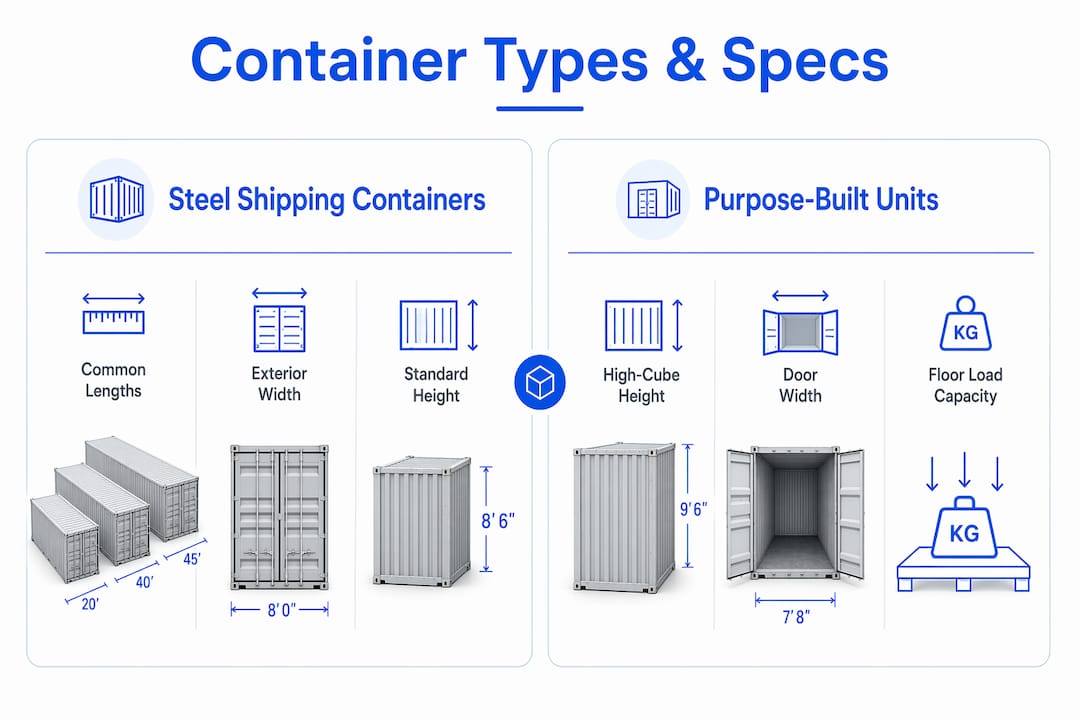
For every listing, publish external dimensions, interior usable space, door opening width, and floor load capacity. Those four data points answer the questions buyers ask before they call.
Which use cases should you promote on your container landing pages?
The buyers searching for portable storage solutions fall into predictable segments, and your landing pages should speak to each one directly.
- Jobsite and construction storage: Tools, lumber, and materials need a lockable, weatherproof unit on-site. Target queries like "construction site storage container" and "job site storage rental."
- Retail and seasonal overflow: Retailers needing extra inventory space between seasons are strong rental customers. Position 20-foot units as the right fit.
- On-site business inventory: Manufacturers, distributors, and service businesses use containers as permanent or semi-permanent warehouse extensions. Business inventory storage is a growing segment worth a dedicated landing page.
- Residential moving and temporary storage: Customers relocating or renovating want a unit delivered to their driveway, packed on their schedule, and picked up when ready.
The delivery model matters for local search intent. "On-site delivery" targets buyers who want the container at their location. "Facility pick-up" targets buyers who will transport items themselves. Use both phrases on the same page, but in separate sections, so each matches its own search query.
Pro Tip: Write one use-case paragraph per customer segment, each containing the exact phrase a buyer in that segment would type into Google. "Temporary storage container for home renovation" and "portable container for construction site" are different queries with different buyers behind them.
Should your customers rent, lease, or buy? Here's how to frame it on your pages
Mobile Modular's guidance is straightforward: rent for short-term or temporary needs, lease for multi-month projects, purchase when the need is ongoing and consistent. Translating that into listing copy is where most operators leave money on the table.
A simple decision card on your product page does the segmentation work before a customer calls. Frame it like this: projects under 3 months, rent; 3–12 months, lease or extended rental; beyond 12 months with consistent use, purchase. Customers who self-select into the right option convert faster and complain less.
Watch for signals that suggest upselling to purchase: a customer who has rented the same unit for more than two consecutive renewal periods, or one who asks about modifications like shelving or electrical. Those are buyers who haven't been shown the purchase option yet.
Pro Tip: Add a "Rent vs. Buy" comparison card to your most-visited container product page. A two-column layout with duration, total cost, and flexibility notes reduces phone calls and increases time-on-page, both of which signal quality to search engines.
What security and weatherproofing specs should appear on every listing?
Buyers evaluating portable storage options want to know the unit will keep their contents safe and dry. Vague language like "secure and weatherproof" does not convert. Specific specs do.
Security features to list explicitly:
- Lockbox or hasp type (recessed lockbox is harder to cut than an exposed hasp)
- Door reinforcement and hinge type (tamper-resistant hinges prevent door removal)
- Recommended lock standard (a hardened steel padlock, minimum 50mm shackle)
- Number of locking points on cargo doors
Weatherproofing and structural specs:
- Floor type (hardwood, bamboo composite, or steel checker plate)
- Seal condition and venting (cross-ventilation prevents condensation buildup)
- WWT certification meaning: the unit keeps wind and rain out, but is not necessarily airtight
- Steel gauge and floor load capacity appropriate for ISO containers
- Door opening width and height (standard cargo door roughly 7–8 feet wide by about 7 feet tall)
High-cube units add 12 inches of interior height, which matters for anyone stacking pallets. Call that out on the listing. Buyers moving palletized inventory will filter specifically for it. For more on storage facility security standards, the specs above align with industry best practices.
How do you write container pages that rank in search and show up in AI answers?
This is where most storage operators underinvest. A container product page that lists dimensions but skips intent signals will rank below a thinner page that answers the buyer's actual question.
- Keyword strategy: Use "portable storage container" as your primary term, then layer in commercial variants: "rent portable storage container," "buy 20-foot shipping container," "portable storage container delivery [city]."
- Page anatomy checklist: Definition sentence, specs table, condition class, delivery/placement notes, rent vs. buy options, pricing examples, and at least five customer reviews.
- Disambiguation line: Place "physical steel container, not cloud or SSD storage" in the first paragraph and in your meta description.
- Schema markup: Use
Productschema for purchase listings,LocalBusinessschema for facility pages, andFAQPageschema for any FAQ section. These three schema types are the ones AI systems parse most reliably for storage queries. - FAQ snippets: Write two or three FAQ entries targeting People Also Ask results: "What is a portable storage container?", "How big is a 20-foot storage container?", "Can I put a portable container in my driveway?"
Pro Tip: Use digital tools for container listings to automate schema generation and track which container pages are being cited in AI-generated answers. Corvanesystems runs this audit for storage operators as part of its AI visibility service.
What U.S. compliance and placement issues should you publish before delivery?
U-Haul's placement guidance and SiteBox Storage's site-prep notes both flag the same recurring problems: soft ground, low clearance, and inadequate turning radius for the delivery truck. Publish a site-ready checklist on your booking page and you will cut post-delivery complaints significantly.
Site-ready checklist to publish:
- Level surface (gravel, asphalt, or concrete preferred; soft soil requires ground protection)
- Minimum 14' overhead clearance for delivery vehicle and crane arm
- Adequate turning radius for a flatbed or tilt-bed truck (typically 40'–50' for a 40-foot container)
- No overhead power lines within the placement zone
- HOA approval or municipal permit confirmed before scheduling
On the compliance side, U.S. municipalities vary widely on how long a container can sit on a residential property. Some counties, like Fairfax County in Virginia, classify portable storage containers as requiring an administrative permit for placements beyond a short window. Include a one-line caution on your booking page: "Local permit requirements vary. Confirm placement rules with your municipality before scheduling delivery." That line protects you and sets the right expectation.
How should you present capacity and pricing on your listing pages?
Capacity framing helps buyers self-select the right unit size without calling. Use room equivalents alongside cubic footage.
| Container Size | Approx. Interior Volume | Room Equivalent | Payload Range |
|---|---|---|---|
| 10-foot | Moderate interior volume typical for small living spaces | Studio or 1-bedroom equivalent | Payload suited for lighter loads |
| 20-foot | Larger interior volume suitable for modest household storage | 1–2 bedroom home equivalent | Payload range supports typical moving needs |
| 40-foot | Largest standard size with significant interior volume | 3-bedroom home equivalent | Payload capacity supports heavy commercial or industrial loads |
Moving containers can hold from roughly 2,000 to 5,200 pounds depending on type and model. For pricing, show the structure clearly:
- Base monthly rental: Varies by size and condition class; publish a range, not just "call for pricing"
- Delivery fee: Typically a flat fee based on distance from your yard
- Security deposit: State the amount and refund conditions explicitly
- Optional services: Relocation, locking hardware, interior lighting
- Purchase price bands: New (one-trip) vs. used (WWT or cargo worthy) should be separate line items
"Call for pricing" is a conversion killer for container pages. Buyers comparison-shopping online will skip to the next result. Even a range ("$150–$250/month depending on size and condition") keeps them on the page.
What maintenance does a portable storage container actually need?
Steel containers are low-maintenance by design, but "low" is not "none." The floor is usually the first thing to go, especially in humid climates where moisture wicks up through the wood. Inspect the floor annually for soft spots, rot, or delamination. Treat it with a penetrating wood sealer every two to three years.
Door seals and gaskets dry out and crack over time, which is how WWT units lose their weather resistance. Check seals at every rental turnover. A $15 replacement gasket prevents a $500 mold remediation claim. The exterior steel should be inspected for rust spots, particularly at weld seams and corner castings. Surface rust treated early with a rust-inhibiting primer stays surface rust. Left alone, it becomes a structural problem.
For long-term storage protection, operators should also advise customers to use pallets or dunnage bags to keep contents off the floor and away from walls, reducing condensation contact.
What insurance and liability considerations apply to operators?
Operators renting or selling portable containers carry liability exposure on two fronts: the container itself and its contents. Most commercial general liability policies cover the container as business property, but contents stored by a third party typically fall outside that coverage. Make that clear in your rental agreement.
Require customers to carry their own renters or homeowners insurance covering stored goods, or offer a declared-value protection plan as an add-on. For delivery, confirm that your transport contractor carries cargo liability insurance. If the delivery driver damages a customer's driveway or fence, you want that covered before the dispute starts.
Placement liability is a growing issue. If a customer places a container without a required permit and the municipality fines them, some will attempt to hold the operator responsible. A one-sentence waiver in the rental agreement, stating that the customer is responsible for confirming local permit requirements, is standard practice and worth having your attorney review.
How do portable containers fit into a sustainability story?
Used shipping containers are a genuine circular-economy product. A container that has completed its shipping life gets repurposed rather than scrapped, which avoids the energy cost of producing new steel. Eveon Containers frames used-container sales as part of a circular-economy approach, and that framing resonates with commercial clients who have sustainability reporting requirements.
For operators, this is a differentiator worth putting on the page. A one-trip container is near-new steel. A cargo-worthy or WWT unit is reclaimed material with a documented second life. Neither framing requires greenwashing. The sustainability story is simply accurate. Commercial clients, particularly in construction and retail, increasingly ask about it.
Key Takeaways
A portable storage container is a physical steel unit, and every listing page must say so explicitly to filter irrelevant digital-storage traffic and attract qualified buyers.
| Point | Details |
|---|---|
| Label pages as physical containers | Add "physical steel container, not cloud or SSD storage" near the H1 and in meta descriptions to cut irrelevant traffic. |
| Publish full specs and condition class | List external dimensions, interior volume, door opening size, floor load, and condition class (one-trip through as-is) on every product page. |
| Use rent vs. buy decision cards | Display a short duration-based guide (under 3 months: rent; 3–12 months: lease; 12+ months: buy) to speed customer self-selection. |
| Add schema and FAQ markup | Use Product, LocalBusiness, and FAQPage schema so AI systems and search engines can parse and cite your listings accurately. |
| Corvanesystems for AI and local visibility | Corvanesystems audits and optimizes container listing pages for AI citation, local search, and schema, helping operators attract more qualified leads. |
What operators consistently underestimate about portable container pages
Most storage operators treat portable container listings as a secondary product, something to add to the site after the main unit types are covered. That's the wrong call. Container queries carry strong commercial intent, the buyer already knows what they want, and the pages that answer the question directly and completely are the ones that get cited in AI answers.
The disambiguation problem is real and underappreciated. "Portable storage container" returns a mix of physical container results and digital storage results in AI tools. Operators who add a single clarifying sentence near the top of their page, and back it with FAQPage schema, consistently outperform those who don't. The fix takes twenty minutes and the payoff compounds every time an AI tool cites your page instead of a competitor's.
The other overlooked factor is condition class. Operators who explain the difference between a one-trip and a WWT unit on the product page attract buyers who are ready to decide. Operators who leave it vague attract buyers who need three more phone calls before they commit. Transparent specs are not just good SEO. They are a conversion tool.
Corvanesystems gets your container listings found by the right buyers
Most storage operators have container pages that describe the product but don't rank for it. The gap is almost always the same: missing schema, no disambiguation line, and content that answers the wrong question. Corvanesystems fixes that gap specifically for self-storage facilities.
The service covers technical SEO, on-page optimization, FAQPage and Product schema implementation, and 30 AI-optimized articles published monthly, all structured so that ChatGPT, Perplexity, Claude, and Google's AI Overviews recognize and recommend your facility. Local search positioning targets "storage near me" and city-specific container queries in your service area. The result is more qualified traffic, fewer irrelevant clicks, and container rental leads that are already pre-sold on what you offer.
One flat monthly rate, no contracts, no minimums. See how Corvanesystems works and request an AI visibility audit for your container listings.
Useful sources
- SiteBox Storage: Portable Storage Containers Explained — Best source for standard container dimensions, condition classes, and site-prep requirements. Cite for specs and WWT definitions.
- SiteBox Storage Blog: Portable Storage Container Guide — Detailed practitioner guide covering condition classification and listing best practices.
- Mobile Modular: Portable Storage Solutions Overview — Use for rent vs. buy guidance and spec table examples.
- U-Haul: What Is a Portable Storage and Moving Container? — Payload ranges, placement requirements, and consumer-facing delivery notes.
- Eveon Containers: What Is a Portable Storage Container? — Market insight on sustainability framing and circular-economy positioning for used containers.
- Fairfax County Planning & Development: Portable Storage Container (Administrative Permit) — Primary government source for U.S. municipal permit requirements; cite when advising customers on placement compliance.