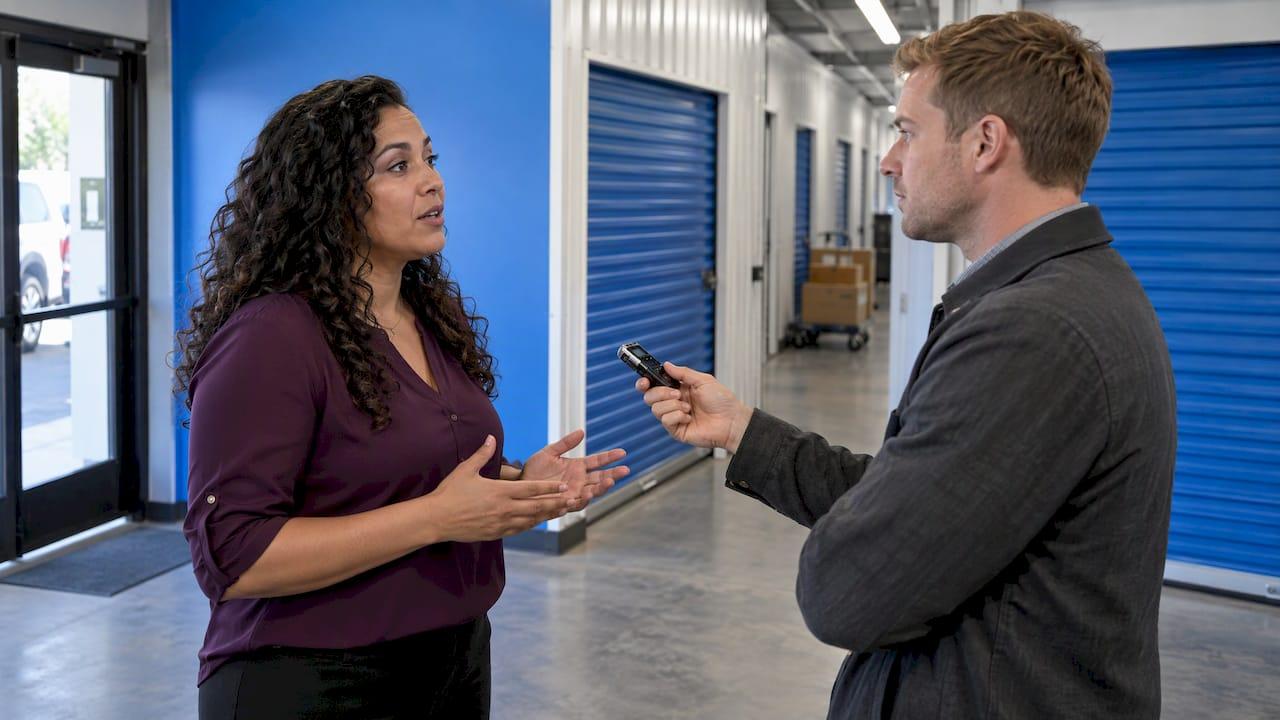
Digital PR for a self-storage facility means earning coverage and links from local news, trade publications and community sites by giving them something worth reporting, then making sure the traffic that follows lands on a site and a Google Business Profile ready to turn it into move-ins. It works best as a small, steady local program, not a national campaign. The most useful stories are built on your own market data, your community work and your operator expertise.
This guide covers what digital PR is, what makes a storage story newsworthy, how to find and pitch the right reporters, which backlinks are worth chasing, and how to measure the outcome.
TL;DR
- Digital PR earns brand mentions and backlinks from real publications by offering them a story. Link building alone targets links for rankings.
- For a storage operator, the best stories are local: market data, community involvement and expert commentary on moving, downsizing and clutter.
- Build a short, verified list of local and trade reporters, and send tight pitches that lead with the finding.
- Judge results by relevant links, referral traffic and inquiries or reservations, not by the number of mentions.
- Coverage only pays off when your site, Google Business Profile and content are ready for the visitors it sends.
Table of Contents
- What digital PR means for a storage operator
- What makes a storage story newsworthy
- Build a media list that reporters will not ignore
- How to write the pitch
- Which backlinks are worth the effort
- Prepare the site before the coverage lands
- How to measure digital PR results
- A realistic monthly rhythm
- Put the foundation in place first
- FAQ
- Sources
What digital PR means for a storage operator
Traditional PR tried to get a feature in a newspaper or on a radio show. Digital PR does the same job online: you get coverage, citations and links on news sites, niche publications, trade journals and community blogs. Search Engine Journal describes it as brand coverage on outlets that do not accept guest posts, paid links or unvetted contributors, aimed at awareness and traffic. It contrasts this with link building, which pursues links to improve rankings without tracking traffic or sales.
That difference matters for a facility owner. A link from a page that real people read sends visitors. It also tells search engines and AI assistants that your facility is a known, trusted business in a specific place. Our guide to types of storage facility backlink sources lays out the full range, from directories to local organizations.
If you want a plain explanation of why earned coverage beats rankings-only tactics, this overview of high authority backlinks compares the approaches.

Why backlinks are the lasting payoff
Search Engine Land notes that digital PR can build brand citations, backlinks and E-E-A-T (the experience, expertise, authority and trust signals search engines look for), and that relevant, high-quality backlinks can lift both the linked page and the domain overall. It also calls backlinks probably the most valuable SEO result of online media attention. For a single-location or small multi-location operator, a handful of links from the local paper, the chamber of commerce and a trade site can matter more than dozens of unrelated ones.
What makes a storage story newsworthy
Reporters do not cover "a facility with great units." They cover things that are new, local, numerical or useful. The simplest method is a three-step local approach described by Ahrefs: choose a topic people already care about, attach local data to it, and send it to local journalists.

For storage, that gives you several angles.
Market data with a local twist
The national backdrop is already newsworthy. A May 2025 report in REBusinessOnline cited an industry study projecting the U.S. market to reach $85.3 billion by 2030, with more than 52,000 facilities and 14.6 million households using storage. It also reported national average rents of $75 a month, down 24% since 2023, and occupancy around 85%. The Self-Storage Almanac 2024 puts the industry at over $44.3 billion in 2024 and household penetration at 11.10%, based on the SSA's 2023 Demand Study.
Those are national numbers. A local reporter wants to know what they mean in your county: how rents have moved in your town, how many new facilities opened, and what is driving demand. If you track your own street rates, occupancy trends or move-in reasons, you hold data the paper does not. Our explainers on self-storage demand and market saturation help you frame the numbers.
One caution: publish only figures you can stand behind. Use your own records, state clearly what period they cover, and cite the original source for anything national.
Seasonal and life-event stories
Storage demand follows life events: moves, graduations, downsizing, renovations, deployments and weather. Local outlets run seasonal service pieces every year, and an operator who can offer a short, practical answer is a ready-made source. Examples of angles that need no invention:
- A checklist for moving during the summer rush, with tips on unit sizing.
- Advice on storing items safely through winter or hurricane season in your region.
- What to do with a relative's belongings after a downsizing.
- Which items should never go in a unit, with the reasons.
Each angle should include one concrete local detail, such as a typical size for a one-bedroom apartment move in your market, so the reporter can quote you rather than rewrite a generic tip.
Community stories
Food drives, free units for a local cause, support for a school fundraiser or a sponsored youth team are classic local news. They also produce the natural links covered in our guide to sponsorship links through your chamber and the SSA. Always ask the organization to link to your website when it publishes a thank-you or sponsor page.
Build a media list that reporters will not ignore
Most digital PR fails at the list, not at the pitch. The Public Relations Society of America advises confirming three things before adding anyone: they still work at the publication, still cover the relevant beat, and have not written a similar story in the past six months. It reports that 86% of journalists reject off-beat pitches and 73% say fewer than one in four pitches they receive are relevant.
Three tiers for an operator
PRSA suggests tiering your list. For a storage business, a practical version looks like this:
- Local outlets. Your city or county newspaper, local TV and radio news pages, community and neighborhood news sites, and the business journal if your metro has one.
- Local organizations. Chamber of commerce newsletters, school and nonprofit sites, local real estate and moving-related blogs, and neighborhood associations.
- Industry trade media. Publications that cover self-storage operations and investment. For example, Modern Storage Media says its Messenger publication, first published in 1979, accepts relevant press releases and story ideas by email to its publisher.
How to find the right person
Mailchimp's guide suggests identifying five to ten publications that might feature your business, reading their recent stories, and using each masthead to find editors' and writers' names and contact details. It also recommends setting up Google Alerts for business-related keywords so you see who covers your topics. Muck Rack's pitching guide quotes a Denver Post reporter who says she is most interested in what happens at the grassroots level, which is good news for a neighborhood business.
Before you send anything, read the reporter's last several articles. Note what they cover, who they quote and whether they have written about storage recently. A story that fills a gap, such as a missing local expert or missing local data, is far easier to say yes to.
How to write the pitch
Keep it short and make it easy to publish. PRSA recommends a pitch a reporter can turn into a story in about 15 minutes: a subject line under ten words, two to three concise paragraphs, the strongest hook first, and data, quotes or visuals up front.
A simple pitch structure
- Subject line: State the finding or the local angle. Example: "Local storage rents fall as new units open in [your town]." Use your real number only if it is real.
- First paragraph: The news, in two sentences. What changed, and why it matters to readers in your area.
- Second paragraph: Your supporting data or the specific community action, with the time period named.
- Third paragraph: Who you are, that you are available for comment, and your direct phone number and email.
Mailchimp adds that a pitch should lead with a human-interest angle rather than an advertisement, say why it matters right now, avoid large attachments and share images by link instead. Never paste your rate sheet into the email. The goal is a story, and the link to your facility follows from being the source.
Follow-up and reactive requests
One polite follow-up after several business days is normal. Beyond that, move on. You can also respond to reporter requests for expert sources. One 2026 digital PR guide recommends answering such requests within an hour with a short, quotable reply, and notes that it can take roughly ten to fifteen responses per placement. Treat that as a rough rule of thumb from one practitioner, not a promise. For a storage operator, queries about moving, downsizing, home organization and small business tend to fit best.
Which backlinks are worth the effort
Not every link helps. A link from a relevant, local or industry page does more than one from an unrelated site, and one that sends actual readers does more than one that sits in a footer. In practice, the best targets for a storage facility are:
- Local news stories that mention you as a source and link to your site.
- Chamber of commerce, business association and sponsor pages.
- Nonprofit and school pages for causes you support.
- Local business partners such as movers, realtors, property managers and contractors who can reference you.
- Trade publications and industry directories.
A sound rule is to prefer relevance over volume. If you want a fast start, our three-week local links plan shows the sequence for map pack and AI visibility, and our self-storage SEO guide puts links in the context of the rest of local search.
Why AI assistants care too
People now ask ChatGPT, Perplexity and Google's AI Overviews where to rent a unit. These systems lean on what the web says about a business: consistent facts, third-party mentions and clear, structured pages. Local coverage that names your facility, your town and your services reinforces that picture. Your own pages need to state those same facts plainly, which is the subject of our piece on server-rendered facts and AI recommendations.
Prepare the site before the coverage lands
A story in the local paper sends a burst of curious visitors. If they hit a slow page, a missing unit-size list or an unclaimed map listing, the coverage is wasted. Before you pitch, check that:
- Your unit sizes, access hours, address and phone number are accurate and identical on your site and Google Business Profile.
- Every page that a reporter might link to, such as a location page, a moving-tips article or a community page, is live and loads quickly.
- You have a clear reservation or contact path on mobile.
- Your internal links point readers from the page that earns links to the pages that rent units. Our internal linking playbook explains how.
How to measure digital PR results
Search Engine Land recommends evaluating each campaign by measuring results, assessing what worked and what did not, and preparing the next one. For an operator, keep the scorecard small:
| Measure | What to record | Where to find it |
|---|---|---|
| Placements | Outlet, date, whether the story names your facility | Your own log and Google Alerts |
| Backlinks | Linking page, whether the link is live, relevance to storage or your town | Your SEO reporting |
| Referral traffic | Visits from the linking page | Google Analytics |
| Branded searches | Searches for your facility name in the weeks after | Google Search Console |
| Leads | Calls, form fills and reservations after the coverage | Your phone log and management software |
The last row is the one that pays the bills. Ask every new tenant how they found you, and note any who mention an article or event. Expect lag: a story can send traffic the same week, but its ranking benefit builds as search engines process the new link.
A realistic monthly rhythm
You do not need a campaign every month. A workable routine for a busy owner:
- Week one: Pull your own numbers, such as occupancy trend, popular unit sizes or move-in reasons, and pick one angle.
- Week two: Verify five to ten local reporters and write a short pitch for each.
- Week three: Send, then follow up once.
- Week four: Log results, request links where a story ran without one, and thank the reporter.
A community sponsorship or a trade-press note can run alongside this in the background.
What we think about digital PR for storage
Digital PR is one of the few tactics that builds trust in a market, not just rankings. We built Corvane for self-storage operators because we see the same pattern: the facilities that get recommended, in Google's map results and inside AI answers, are the ones with a technically sound site, a well-run Google Business Profile, consistent local content and credible mentions around them.
That is why our system is built around the foundation. It combines technical and on-page SEO, local search positioning, AI-optimized content with 30 articles published monthly, and AI visibility audits that score how you appear across ChatGPT, Claude, Perplexity and Google AI. Earned coverage adds real weight when it points at a site set up like that.
Our advice to owners: pick one local story a quarter, tell it well, and make sure every visitor it sends lands somewhere built to turn them into a tenant.
Mike
Put the foundation in place first
The full Corvane system is a flat $299 per month, with a one-time onboarding fee of $50, no contracts and no minimums. It covers technical and on-page SEO, local search work including Google Business Profile optimization and competitor tracking, 30 articles a month, AI visibility audits and a straightforward monthly performance summary. We also offer a free AI visibility audit, so you can see how your facility appears today before you pitch anyone. You can see the details on the Corvane Systems pricing section, and our SEO cost breakdown for U.S. storage operators explains what budgets typically cover.
FAQ
Is digital PR the same as link building?
No. Link building targets links to improve search rankings. Digital PR earns coverage, mentions and links from real publications by offering them a story, and it aims at awareness and traffic as well. The links are a result of the coverage, not the goal.
How many backlinks do I need?
There is no fixed number. Relevance matters more than count, so a few links from local news, your chamber and industry sources are worth more than many unrelated ones. Focus on pages real people read and that connect to your market.
How long does digital PR take to work?
A placement can send visitors within days of publishing. The search ranking benefit builds more slowly as the new links are found and weighed. Plan on a steady program over several months, and track branded searches and inquiries along the way.
What should a small operator pitch if there is no big news?
Use local data you already have, seasonal advice, a community project or expert commentary on moving and downsizing. Pair one concrete local detail with a practical tip, and offer yourself as a source for reporters covering those topics.
Where do I send trade press releases?
Industry publications publish contact details for story ideas. One example is that Modern Storage Media accepts relevant press releases and story ideas by email, as listed on its FAQ page. Read recent issues first so your note fits what they cover.
Sources
- Ask An SEO: Digital PR Or Traditional Link Building, Which Is Better? (Search Engine Journal)
- Digital PR for SEO: How to Earn Backlinks, Authority & More (Search Engine Land)
- The Tabloid Technique: How to Easily Land Local Links (Ahrefs)
- Falling Rents, Shifting Demand Among Self-Storage Trends to Watch in 2025 (REBusinessOnline)
- Self-Storage Almanac 2024 (Modern Storage Media)
- Media Relations Best Practices: Building Journalist Relationships (PRSA)
- FAQ (Modern Storage Media)
- A Guide on Finding Journalists to Write About Your Business (Mailchimp)
- Guidebook to pitching (Muck Rack)
- Digital PR for High-Quality Backlinks: 2026 Playbook
- High Authority Backlinks: How to Earn Them in 2026