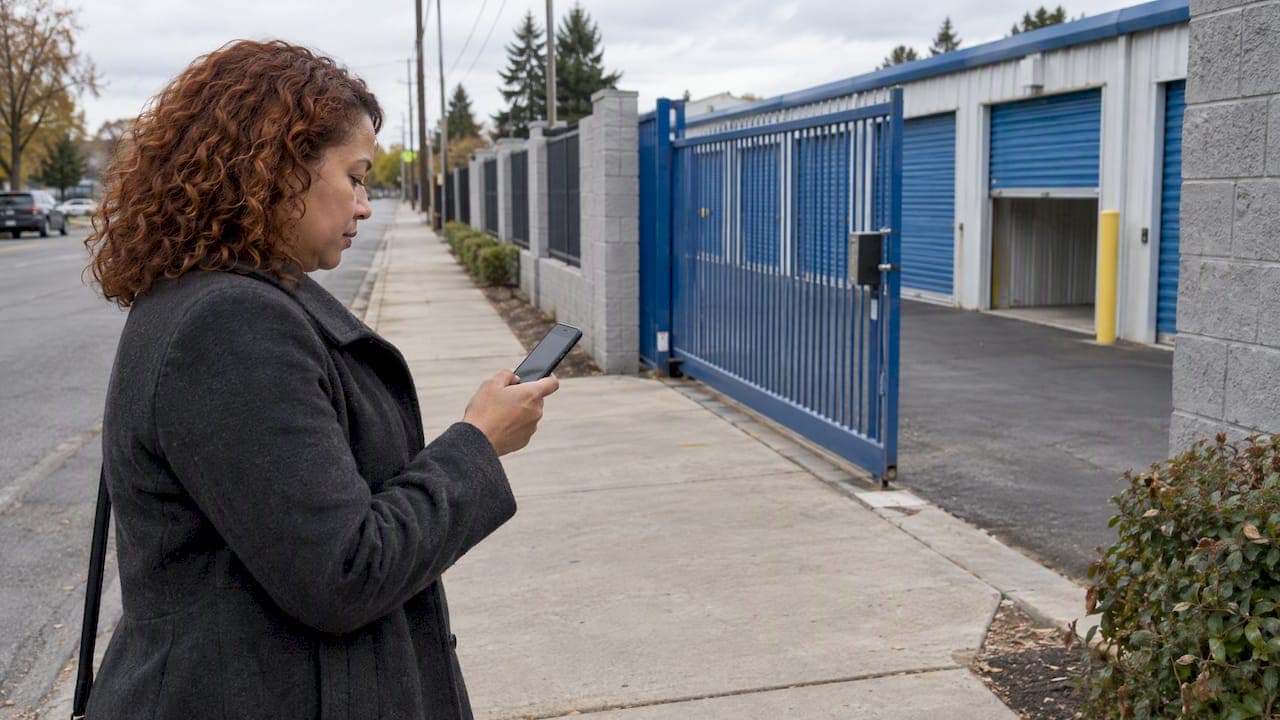
Near me optimization means making your facility the clearest local answer when someone searches "storage near me" on Google, in Maps or in an AI assistant. You do not win it by stuffing "near me" into your pages. You win it with an accurate Google Business Profile, a strong set of reviews, location pages that state real facts, and links and mentions from your own market. Google's own guidance says local results come down to relevance, distance and prominence, and each of those is something you can influence.
This guide is written for self-storage owners and operators. It covers what "near me" optimization means for a facility, how the ranking works, what to fix first, and how to tell whether it is working.
TL;DR
- "Near me" searches are decided by relevance, distance and prominence. You cannot control distance, so put your effort into the other two.
- Your Google Business Profile is the first thing to fix: accurate details, hours, photos and a steady flow of reviews.
- Give every facility its own page with a unique city-focused H1, full address, phone, hours, real content and calls to action.
- Write for people. Awkward "near me" phrasing on a page reads as spam and does not help.
- Check rankings from several spots around your market, because results change with the searcher's location.
Table of Contents
- What near me optimization means for a storage facility
- How Google decides which facilities show up
- Fix your Google Business Profile first
- Build location pages that answer nearby searchers
- How to use the words "near me" without hurting yourself
- Common mistakes self-storage owners make
- Near me searches and AI assistants
- > Perspective
- Can you do this yourself?
- Measure whether it is working
- How we help
- FAQ
- Sources
What near me optimization means for a storage facility
A "near me" search is a request for proximity. The person typing "self storage near me" or "storage units open now" wants a facility close by, and Google fills in the location from their phone or device. Search Engine Land describes near me optimization as improving a local business's visibility for these proximity-driven searches, and it warns that clumsy "near me" wording can make website content look spammy.
That last point matters for storage sites. Many operators put "storage near me" in headings, footers and image names. Google already knows where the searcher is and where your facility is. What it needs from you is proof that you are a relevant, real, well-regarded storage business at a specific address.
So in practice, near me optimization is local SEO with a clear focus: make the signals Google uses to match a nearby searcher to a nearby business as strong, consistent and complete as you can. The same signals increasingly feed AI assistants, which pull from your profile, your site and the reviews and mentions around them.
How Google decides which facilities show up
Google states that local results are based mainly on three factors, and it explains them plainly on its local ranking help page:
| Factor | What it means | What you can do |
|---|---|---|
| Relevance | How well your profile matches what the person searched for | Complete every profile field, choose accurate categories, list the unit types and services you actually offer |
| Distance | How far you are from the searcher | Nothing about the location itself, but you can make sure your address and pin are exactly right |
| Prominence | How well known your business is, from links, reviews and your wider online presence | Earn reviews, local links and mentions; keep your information consistent everywhere |
Two details from that same page are worth remembering. First, Google says there is no way to request or pay for a better local ranking. Anyone selling a guaranteed map position is selling something Google says does not exist. Second, complete and accurate information helps you appear in relevant searches, and more reviews and positive ratings can help your local ranking.
Why proximity feels unfair, and what to do about it
If a competitor sits closer to the center of town than you do, they will often have an edge for searchers standing nearby. Search Engine Land's work on distance bias says businesses can build prominence with authoritative links from local and industry websites and by strengthening their online presence. For a facility on the edge of a city, that is the lever: more evidence that you are the established, trusted choice, so you are competitive even when you are not the closest.
Fix your Google Business Profile first
For most facilities, the Business Profile does more for "near me" visibility than anything on the website. Google's getting started guide tells owners to keep information accurate, provide hours, website, phone number and location, add photos and videos, and collect and respond to reviews. Treat that as a checklist.
- Name, address and phone. Use the same name, address and number that appear on your website and in directories. Inconsistency makes it harder for Google to trust that these listings describe one business.
- Hours, and separate office and gate hours. Storage is unusual: the office may close at 5 p.m. while customers have gate access much later. Say so clearly in your hours and description, because "open now" searches are common.
- Categories and services. Choose the category that matches what you are, and add the details renters care about: climate control, drive-up units, vehicle storage, 24-hour access.
- Photos and video. Show the entrance, the driveway, the office, the hallways, the unit doors and the security features. Search Engine Land notes that photos, videos and first-party reviews help show that a business is a legitimate local entity at a stated location.
- Website link. Point the profile to the page for that specific facility, not a generic homepage, if you run more than one.
- Reviews. Ask every happy tenant, reply to every review, and do it every month, not in a burst.
If you want a structured way to check all of this, our Google Business Profile audit for self-storage facilities walks through it item by item. If you have moved or renumbered your building, read how to change your Business Profile address before you touch anything, since a careless edit can cause problems.
Reviews that say something specific
Reviews are part of prominence, and their content matters as well as their count. Search Engine Land's analysis says earning reviews that mention specific aspects of a business, such as amenities or services, can help it become more visible for those features. For storage, that means reviews that mention the climate-controlled units, the easy move-in, the clean hallways or the helpful manager.
You cannot script what tenants write, and you should never offer payment for reviews. What you can do is ask good questions at the right moment. A text a few days after move-in that says, "What did you like about the move-in process or the unit?" tends to draw out the details that help future renters and help Google understand what you offer.
For operators with several sites, the guidance is to run an ongoing review program for each branch and to respond quickly to every review, as Search Engine Land's multi-location guide describes it. Responding is also how you show prospective renters that someone is paying attention.

Build location pages that answer nearby searchers
Your website supports the profile. Each facility should have its own page that tells a nearby searcher, and Google, everything needed to choose you.
Search Engine Land's recommendations for local contact pages say a local page should include the business name, complete address, phone number, hours, location-specific content, reviews or testimonials and calls to action. For a storage facility, a strong page looks like this:
- A unique H1 with the city or neighborhood, since industry guidance on multi-location sites recommends each location page carry its own city-intent H1.
- The full address, a phone number people can tap, and office and access hours.
- The unit sizes and types available at that site, with a clear path to reserve or call.
- Directions and landmarks: which exit, which cross street, where to park the truck.
- Photos of that facility, not stock images.
- Reviews or testimonials from that location's tenants.
- A few lines of local content that only someone who knows the area would write: the nearby neighborhoods you serve, the military base, the university, the seasonal moves.
Avoid copy-and-paste pages
The fastest way to waste a multi-facility site is to clone one page and swap the city name. Search Engine Land's perspective on multi-location SEO is that the goal is to give each branch a chance to be found by its community, using location-specific landing pages and consistent information. If you want a deeper look at building distinct landing pages for each location without creating page sprawl, that is worth reading alongside our own guides on duplicate content across storage locations and the 10 point location page playbook.
If you also serve neighboring towns from one facility, a service area page can work, but only when it is built around real logistics: drive times, access, and which units suit which move. We cover that in making service area pages convert.
Add structured data
Structured data lets you state facts in a form machines read reliably. Google's LocalBusiness documentation explains how markup can tell Google about business hours, address and reviews. Make sure the facts in your markup match the visible page and your profile exactly. Our piece on server-rendered facts and AI recommendations explains why the details should also be present in the page's HTML rather than loaded in later by scripts.
How to use the words "near me" without hurting yourself
People do type "near me," so it is fair to ask whether the phrase belongs on your site. The safe answer: let it appear only where it reads like normal English. A sentence such as "Looking for a storage unit near downtown Tulsa? Our office is two minutes from the Route 66 exit" is useful. A paragraph that repeats "cheap storage near me" five times is not.
Search Engine Land's advice is to avoid awkward "near me" wording that could make content look spammy, and to write people-first content, which is what Google asks for too. Use real place names instead: the city, the neighborhood, the cross streets, the landmarks. Those are the words that make a page specifically relevant to a place, and they work whether the searcher types "near me" or "storage in Tulsa."
Common mistakes self-storage owners make
- Keyword stuffing. Repeating "storage near me" in titles, footers and alt text. Replace it with natural location language.
- Inconsistent details. A different phone number on the website, the profile and a directory. Pick one set and use it everywhere.
- One generic page for every facility. Each site needs its own page and its own profile that links to it.
- Ignoring reviews. Unanswered reviews and months of silence signal neglect to both renters and Google.
- Stock photos. Tenants want to see the actual driveway and the actual door.
- Hiding key facts. Unit sizes, access hours and move-in steps buried in a PDF or a pop-up are hard for people and for AI tools to read.
- Paying for "guaranteed" rankings. Google says you cannot buy a better local ranking.
Our spam-proof Google Maps checklist for self-storage covers the profile side of these mistakes in more detail.
Near me searches and AI assistants
More renters now ask an AI tool where to rent a unit, and the answer draws on the same raw material: your profile, your website, your reviews and what others say about you. A facility with clear, consistent facts and plenty of specific reviews is easier for these systems to describe correctly. A facility with conflicting hours or thin pages is easy to skip.

That is why we treat traditional local SEO and AI visibility as one job. If you want the AI side in depth, start with AI search optimization for your storage business.
> Perspective
We built Corvane Systems for one kind of business: self-storage. That focus changes how we think about "near me." Storage is a proximity purchase made under pressure, a move, a downsize, a renovation, so the renter picks from the first few facilities that look trustworthy and close. If you are not in that short list, in the map pack or in an AI answer, you do not lose a click, you lose the booking.
Most operators we talk to try to fix this with a keyword here and a blog post there. We think that is backwards. The facts about your facility have to be right everywhere first: profile, site, listings. Then you publish content that covers the questions renters actually ask, consistently, month after month. That is why our system combines technical and on-page SEO, local positioning, AI-optimized content and AI visibility audits under one flat rate, with no contracts, so the work is steady instead of a one-off sprint.
Near me optimization is not a trick. It is making your facility easy to understand, easy to trust and easy to recommend, for Google and for the AI tools that are taking over more of the decision.
Mike
Can you do this yourself?
Yes, for the basics. Claiming and completing your profile, asking for reviews, fixing inconsistent listings and writing a real page for each facility are all within an owner's reach. The challenge is consistency: reviews need to keep coming, pages need to stay current, and content needs to keep covering new questions. That ongoing work is where most owners run out of time.
Measure whether it is working
Local results are customized to the searcher's location, so a search from your office tells you little. Search Engine Land's explanation of Maps versus local search rankings says checking rankings at different locations around town shows how results vary. Do exactly that.
- Pick five to ten spots in your market: your own gate, the nearest highway exit, a neighborhood a mile or two away, a big apartment complex.
- Search your main terms from each, in Maps and in regular search, on a phone.
- Record where you appear, who appears above you, and how your profile looks.
- Repeat monthly and compare. Also track calls, direction requests, website clicks from your profile and reservations.
- Ask a few AI assistants where to rent a unit in your town and note whether you are named and described correctly.
A simple monthly record beats a perfect one you never update.
How we help
If you would rather not run all of this yourself, the full Corvane system covers technical and on-page SEO, local search positioning including Google Business Profile optimization and competitor tracking, 30 keyword-optimized articles each month, AI visibility audits and a straightforward monthly report. It is $299 per month with a $50 one-time onboarding fee, no tiers and no contracts. You can start with a free AI visibility audit to see how your facility appears today, and we also build custom websites for storage operators. See the details on the Corvane Systems site.
For a wider view of the local playbook, read our guides on self-storage SEO for facility operators and multi-location SEO for storage.
FAQ
Can I do local SEO myself?
Yes. Completing your Business Profile, collecting and answering reviews, keeping your details consistent and building a real page for each facility are all things an owner can do. The hard part is keeping it up month after month, which is where many operators bring in help.
How do I appear on Google searches near me?
Claim and complete your Google Business Profile, keep your name, address and phone number consistent everywhere, and earn reviews. Then give each facility a page on your website with its address, hours, photos and local content. Google says it cannot be paid for a better local ranking, so the work is about relevance and prominence.
Should I put "near me" on my website?
Only where it reads naturally. Repeating the phrase makes content look spammy, and Google asks for people-first content. Use real city, neighborhood and landmark names instead, since those tell Google and renters exactly where you are.
Is SEO dead now with AI?
No. AI assistants rely on the same foundations: accurate business facts, a well-built website, reviews and mentions. Facilities that keep those strong are easier for both search engines and AI tools to find and recommend.
Sources
- "Near Me" SEO: Optimize for Local Searches That Convert, Search Engine Land
- Tips to improve your local ranking on Google, Google Business Profile Help
- Get started with Google Business Profile, Google Business Profile Help
- The proximity paradox: Beating local SEO's distance bias, Search Engine Land
- Multi-Location SEO: Boost Local Visibility for Each Location, Search Engine Land
- The perfect local business contact page built for Google, Search Engine Land
- How to execute a multi-location website redesign without losing traffic, Search Engine Land
- Local Business (LocalBusiness) Structured Data, Google Search Central
- Google Maps vs Local Search rankings, Search Engine Land
- Local SEO for Multi Location Brands: Templates, Not Page Sprawl